Kepler’s Model
Like Copernicus, Kepler believed that the Sun should be in the center and that planetary orbits should be perfect circles. After years of effort, he found a set of circular orbits that matched most of Tycho’s observations quite well. Even in the worst cases (which were for the planet Mars) Kepler’s predicted positions differed from Tycho’s observations by only about 8 arcminutes, which is barely one-fourth the angular diameter of the full moon.
Kepler surely was tempted to attribute such small discrepancies to errors by Tycho. But he was convinced that Tycho’s observations had been made and recorded very carefully. He therefore concluded that it must be the circular orbits, not Tycho’s data, that were wrong. About this fact, Kepler wrote:
If I had believed that we could ignore these eight arcminutes, I would have patched up my hypothesis accordingly. But, since it was not permissible to ignore, those eight arcminutes pointed the road to a complete reformation in astronomy.
With his decision to abandon perfect circles, Kepler began to try other shapes for orbits, and ultimately found the correct answer: Earth and other planets do indeed orbit the Sun, but their orbits take the shapes of the special ovals known as ellipses.
Activity
What is an ellipse?
The major breakthrough of Kepler’s model was to adopt elliptical orbits instead of orbits that were perfect circles. An ellipse is a special type of oval, with a few specific details in its geometry. Let’s compare by drawing both shapes. First, prepare your materials:
- string at least 12” long
- pencil
- two tacks
- board or cardboard
Draw a circle.
Step 1: Tie one end of a string to a pencil and tack the other end of the string to a board or a piece of cardboard.
Step 2: Pull the string tight and drag the pencil around the tack. This way, you’ve drawn a line that is the same distance (or equi-distant) from the center tack.
(PICTURE: pencil, loop, tack show a bunch of radii same distance)
Mathematically, a circle is perfectly symmetric around its center point. The distance from the center to the edge is the radius, with the radius being the same distance from the center to any point on the edge of the circle.
Draw an ellipse.
Step 1: Tack both ends of the string to the board, about 10 cm apart.
Step 2: Loop the string around the pencil, as shown in the PICTURE. With the pencil looped into the string, drag it around the tacks to draw an ellipse. You’ll see that while the length of string on either side of the pencil may change as you drag it around, the total length of the string stays the same.
Notice there are some key differences between a circle and an ellipse.
(PICTURE: ANATOMY OF AN ELLIPSE)
Clearly, an ellipse is not perfectly symmetric like a circle, however ellipses are symmetric across their different axes (singular: axis). The distance across the narrowest part of the ellipse is called the minor axis. The distance across the widest part of the ellipse is called the major axis. Half of each of these axes is called the semi-minor axis and the semi-major axis, respectively. The locations of tack 1 and tack 2 each represent an individual focus (plural: foci [fo-sigh]) of the ellipse.
One of Kepler’s insights about planetary orbits is that all planets orbit in the shape of an ellipse, with the sun at one focus.
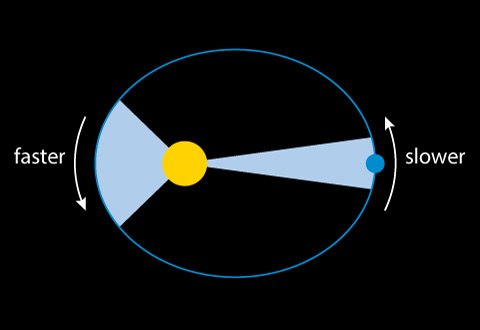
Moreover, Kepler found that planets move faster in the portions of their elliptical orbits in which they are close to the Sun and slower when they are farther away (Figure 3.10).
Journal Entry
Trusting the Data
Put yourself in Kepler’s place when he discovered the discrepancies of up to 8 arcminutes with Tycho’s data. That is, assume that you believe deeply that “heavenly perfection” requires that orbits be perfect circles, but you also trust that Tycho worked carefully in collecting his data. You therefore have a choice: You can stick with your belief in circular orbits if you assume that Tycho just made a few small errors, or you can decide that your deeply held belief in circular orbits must be wrong. Which choice do you think that you would make in that situation? Write a paragraph or two in which you state the choice you would have made and explain why.
Teacher Notes: This journal entry is intended to get students to think about how they personally would deal with a situation like Kepler faced. There is no correct answer, and in fact, the answer is not obvious. After all, until he found a different shape that worked, it’s likely that even Kepler continued to wonder if Tycho’s data might have been in error. (He wrote the words quoted above after he had landed on a model that worked.) So any grading of this entry should be based on how well students articulate the rationale behind the choice they make. For example, some students may argue that you should always trust the data (but make sure they give a reason why), while others might argue that beliefs should be considered equally valid until proven otherwise.
Kepler summarized his discoveries with three precisely stated mathematical laws that we now call Kepler’s laws of planetary motion. He published the first two of these laws, which were the ones needed to match Tycho’s data, in the year 1609. (The third law, which he published a decade later, describes how the orbit of each planet depends on its distance from the Sun.)
Kepler’s laws represent a model of planetary motion that can be used to predict the locations of planets in our sky at any time. Just as with the earlier models of Ptolemy and Copernicus, the process works basically like this:
- Start by observing the current positions of planets in the sky.
- Then use the mathematics of the model to predict future (or past) locations for the planets.
The critical difference is that while the models of both Ptolemy and Copernicus made noticeably inaccurate predictions, Kepler’s model gave essentially perfect predictions.
Kepler’s model also had a second important advantage over the earlier ones: It was much simpler. Recall that calculations with Ptolemy’s model were extremely tedious and complex, and the same was true for Copernicus’s model with the complexity he was forced to add in his attempt to keep circular orbits.
In contrast, Kepler’s model is so simple that it is possible to build clockwork-like mechanisms that can reproduce planetary motion. Figure 3.11 shows one such device, in which each planet moves along an elliptical track, driven by clockwork built to follow Kepler’s laws. Of course, today it is much easier to program Kepler’s laws into a computer than to build a mechanical device. This is essentially how modern software can make perfect predictions of past and future planetary positions.
FIG 3.1.1
Take It To The Next Level
Eccentricity: How close is close enough?
An ellipse is basically a squashed circle. Eccentricity is the term used to describe just how squashed an ellipse is. Ellipses can have an eccentricity of 0 to 1, where 1 represents the “most squashed” or elongated. An eccentricity of 0 represents an ellipse with no elongation, in other words, a circle.
(picture: e=0, 0.3, 0.7, 0.9)
Eccentricity is defined by how close together the foci are. If the foci are close together, the eccentricity is low; as the distance between the foci increases, so does the eccentricity.
We can examine the eccentricity of planetary orbits HERE
The yellow circle in the middle represents the sun, and the grey circle represents the other focus of the ellipse. Notice the values given in the box at the bottom of the animation. What is the eccentricity?
Change the eccentricity of the orbit by moving the foci closer together. Set the eccentricity to the following values, and take note of how the shape of the ellipse changes:
e=0.016
e=0.05
e=0.2
These values represent the entire range of eccentricity in the orbits of planets in our solar system. The planet with the most eccentric orbit is Mercury, with an eccentricity of 0.2. The next highest is Mars with an eccentricity of 0.09, and the eccentricity of Earth’s orbit is only 0.016. So we can see why early astronomers could have easily made the mistake of believing planets had circular orbits.